

Sonali Sharma Launches The 90% Code, Arguing Collective Intelligence Must Replace Hero Leadership in the AI Era
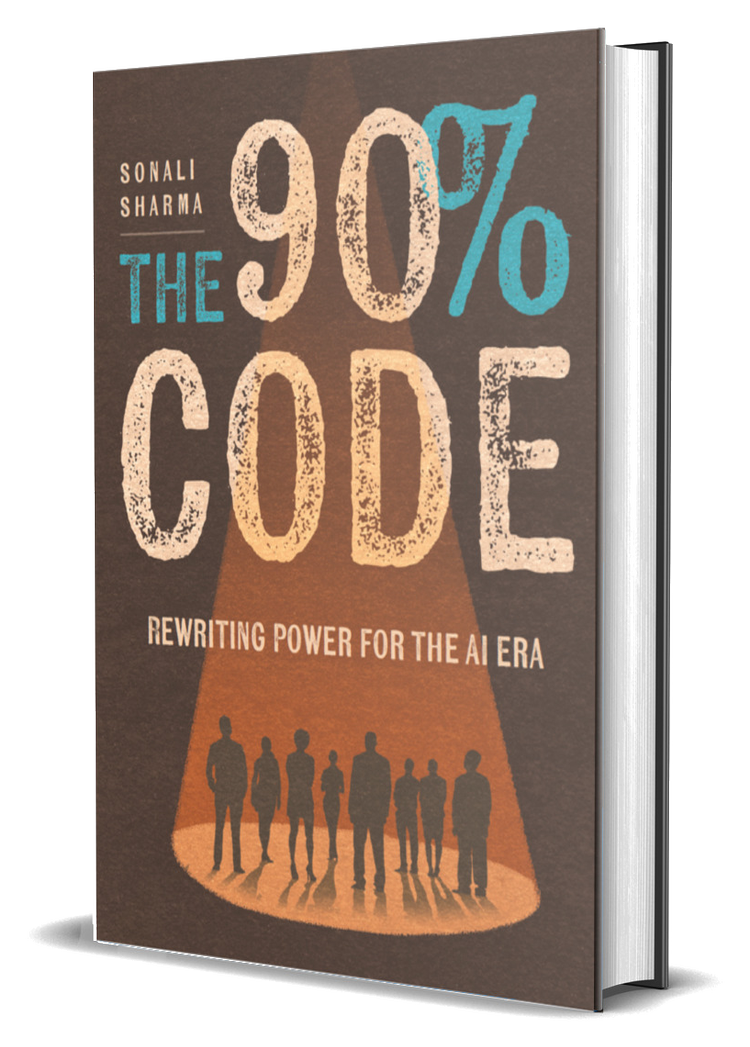
The 90% Code by Sonali Sharma
The new book argues that hero-driven leadership was already failing and that AI is exposing its limits.
“The central question of this moment is not what a single brilliant mind can do. It is what many minds can do together.””
SUMMIT, NJ, UNITED STATES, October 20, 2026 /EINPresswire.com/ -- Systems strategist Sonali Sharma today announced the launch of The 90% Code: Rewriting Power for the AI Era (FriesenPress). In the book, Sharma argues that organizations are adopting AI inside leadership structures already struggling to keep pace, where decisions remain concentrated at the top while those closest to emerging problems lack the authority to solve them.— Sonali Sharma
Sharma contends that the deeper crisis is structural. She calls it the Hero Model: an architecture of leadership, economics and governance in which a few hold power and decide for the many.
“Concentrated authority cannot govern distributed complexity,” Sharma said. “We keep asking leaders to become smarter and faster, when our challenges have outgrown what any individual can understand or control.”
The book focuses on the people Sharma calls “the 90 percent”: those who create value, hold essential knowledge and live with the consequences of decisions, yet have little say in them. Sharma argues that their greatest untapped resource is collective intelligence: the ability of people to think, decide and act together when systems allow them to.
Jos de Blok, founder of Buurtzorg, the Dutch home-care organization of self-managing nurses, writes: “Most books about leadership are about leaders. This one is about the rest of us.”
Kirkus Reviews gave The 90% Code its “Get It” recommendation, calling it “a reflective call to action for individuals, organizations, and humanity as a whole.”
The book’s collective intelligence framework begins with five capacities that develop people: inner alignment, relational intelligence, systems stewardship, ethical foresight and regenerative action.
“Structure without capacity collapses. Capacity without structure dissipates. The 90% Code requires both,” Sharma said.
The structure comes from three infrastructural shifts that convert that capacity into power: economic infrastructure that shares ownership and value with those who create it; democratic infrastructure that gives those affected by decisions meaningful authority; and trust infrastructure that makes AI accountable to the people it affects.
Building on the work of Elinor Ostrom, the Nobel-winning economist who showed that communities often govern shared resources better than top-down control, the book draws on field notes from organizations and communities: Morning Star’s manager-free teams, Mondragon’s worker-owned cooperatives, Amsterdam’s Schoonschip, a floating neighborhood whose households share one peer-to-peer energy grid, Ireland’s citizens’ assemblies, and Bowling Green, Kentucky, where nearly 8,000 residents used AI-assisted deliberation to shape a long-term community plan.
For Sharma, Bowling Green shows that AI can expand a community’s capacity to think together. Inserted into centralized systems, she argues, the same technology can weaken human judgment, deepen dependency and concentrate value among technology owners, leaving organizations renters of intelligence they once owned. The question she poses to leaders is whether their people are becoming more capable or more dependent.
“Accountability without participation is management. Accountability with participation is governance. Accountability that extends across generations is stewardship,” Sharma said. “Most AI today sits at that first level.”
The book offers two applied tools: a System Diagnostic that maps power, information and accountability, and an AI Assessment Framework that tests AI systems across dimensions including human capacity and accountability.
“The answer isn’t better heroes,” Sharma said. “It’s the 90 percent learning to lead together instead of waiting to be led.”
Published by FriesenPress and distributed by Ingram, The 90% Code is available worldwide in hardcover, paperback and ebook. Sharma is available for interviews.
https://www.the90code.com/book
About Sonali Sharma
Sonali Sharma is a systems strategist, entrepreneur and author focused on collective intelligence and AI trust, with two decades of experience across social enterprise, public-sector innovation and education in Asia and Canada. She co-founded a circular manufacturing enterprise with Indigenous artisans in South India, served as Director of Strategy at Innovate BC, and mentors impact-led ventures with Spring Activator. She lives in Vancouver.
Rob Nissen
Nissen Public Relations
+1 908-376-6470
Legal Disclaimer:
EIN Presswire provides this news content "as is" without warranty of any kind. We do not accept any responsibility or liability for the accuracy, content, images, videos, licenses, completeness, legality, or reliability of the information contained in this article. If you have any complaints or copyright issues related to this article, kindly contact the author above.
